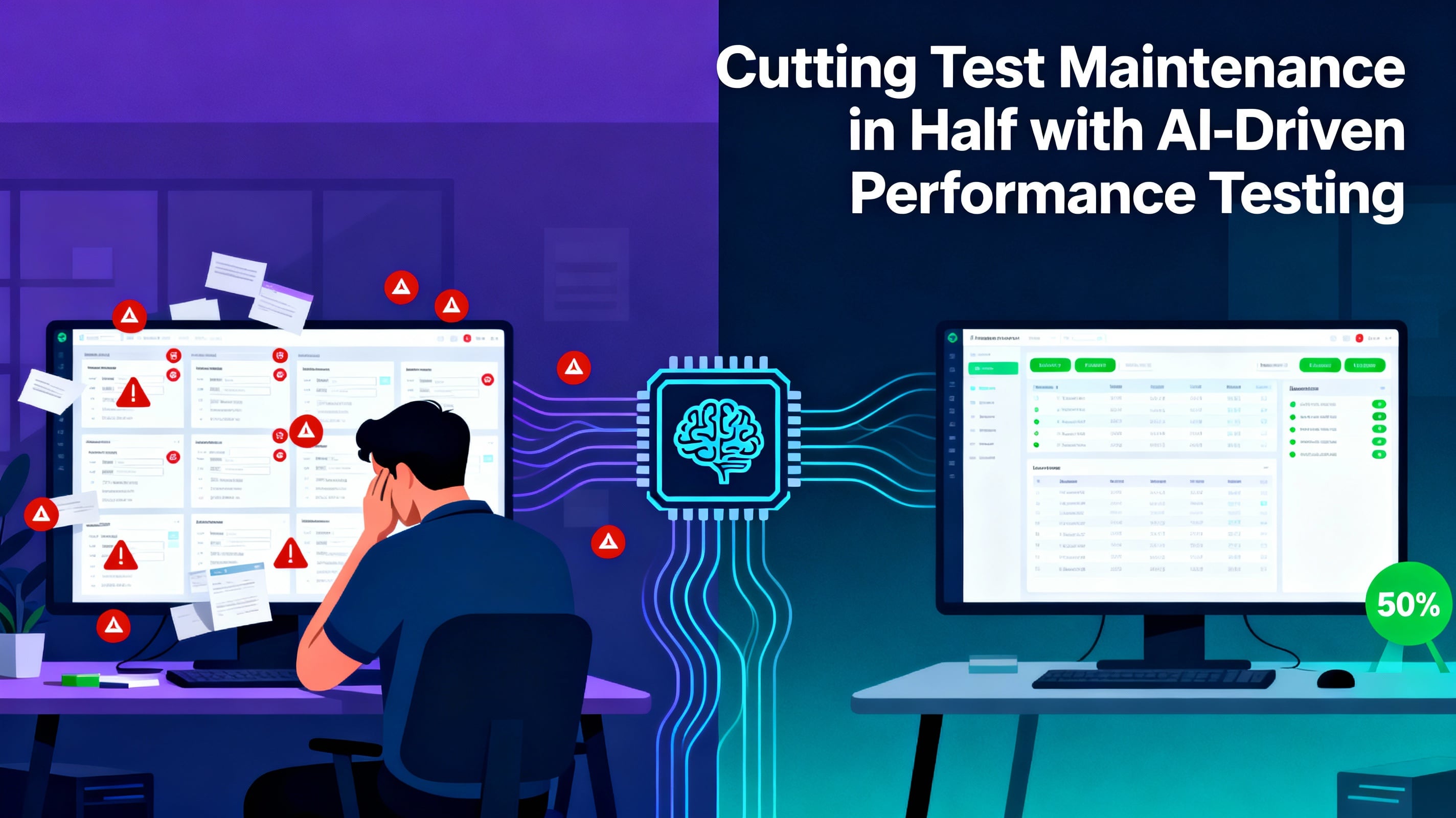
Cutting Test Maintenance in Half with AI-Driven Performance Testing
Next-Gen Software Testing & QA. We help businesses build better software with cutting-edge test automation, AI testing, and performance engineering.
If you've ever run a big performance testing project, you know the drill: hours spent keeping scripts up to date, optimizing environments, and reviewing numerous reports to ensure your app works as it should when it's under strain. It's boring, repetitious, and expensive.
The fact is much of that time isn't spent finding new information. It moves into maintenance, ensuring your test cases, data, and environment don't break every time you make a small change. That's when AI-driven performance testing comes in to change the rules.
Why Traditional Performance Testing Feels Stuck
Traditional performance assessment involves manual correlation, hard-coded thresholds, and human-driven analysis. However, this method doesn't work as apps become more modular, distributed, and API-first.
You have three big problems at the end:
- Scripts that break every time a new version comes out
- Metrics that are hard to understand quickly
- Bottlenecks that only show themselves after problems in production
If testing becomes ineffective and impractical, it's time to update the model.
What Sets AI Performance Testing Apart
AI doesn't just do things for you; it also learns from your data. AI-driven performance testing uses algorithms to look for trends in logs, metrics, and traces across contexts that human testers often overlook. The result is faster detection, smarter correlation, and much less maintenance.
Let's look at the main parts that make this change so strong.
1. Performance Auto-Correlation
In traditional setups, engineers manually connect system logs and response times to find the source of latency or resource spikes. AI does this automatically to auto-correlate performance. It finds links between load parameters, how the infrastructure behaves, and response metrics without any help from people.
What do you get out of it? Faster triage, less manual work, and test scripts that may evolve with the system without breaking.
2. Finding Strange Behavior in Performance
You can't fix something if you can't see it. Machine learning models are used in performance anomaly detection to constantly monitor response times, throughput, and resource use. AI doesn't use set criteria; instead, it learns what "normal" looks like for your system and lets you know when it starts to change.
This means you won't have to go through logs after every test runs anymore. AI shows you strange behavior in real time, which helps you find problems before they become outages.
3. AI for Capacity Planning
People used to prepare capacity by using spreadsheets and educated assumptions. AI-driven capacity planning can tell you how your application will grow with varied workloads. AI accurately predicts resource needs by looking at past performance data and infrastructure parameters, even when traffic patterns are hard to predict.
That information helps teams wisely deploy resources, avoid over-provisioning, keep costs down, and maintain peak performance.
4. Checking the SLA/SLO
Setting SLAs and SLOs is simple. But proving that you meet them all the time is hard. AI makes SLA/SLO certification easier by linking test results to business goals. It checks for compliance by looking at response times, error rates, and throughput data.
You don't get binary pass/fail reports; instead, you see how your performance matches up with service promises in real time. That changes testing from a way to ensure you follow the rules to a way to ensure you do well.
5. Testing for Scalability with Intelligence
Scalability tests should use real-world scenarios, not theoretical loads. AI improves scalability testing by using production data to find the best load patterns. It tells you not only how much your system can manage but also how well it accomplishes it.
You can test how microservices perform, how long data travels across the network, and how well caching works while reducing unnecessary test runs.
6. Bottleneck Analysis: From Guessing to Exactness
When you do manual bottleneck analysis, it can feel like you're a detective: You have to watch for CPU spikes, check databases, and track logs from different places. AI automates this search by linking together different telemetry points to determine where degradation originates and how it spreads.
You don't have to question "why did performance drop?" anymore. AI answers it immediately, with proof that can be traced across the stack.
How AI Cuts Test Maintenance Time in Half
Here's the truth: while intelligence goes up, upkeep goes down.
- AI-driven performance testing cuts down on repetitive manual effort in several ways:
- Dynamic script adaptation means that scripts automatically change as the UI or API does.
- Self-healing test environments: AI automatically restores baselines when settings change.
- Intelligent test prioritization: AI determines the most critical tests for upcoming releases.
- Instead of generic reports, contextual analytics gives insights into your work.
These changes reduce rework, speed up feedback cycles, and let testers focus on more important engineering duties.
Creating a Performance Testing Framework Based on AI
Here's a basic plan to follow if you're ready to get started:
Look at what is slowing you down right now. Find out where maintenance takes up the most time.
- Use tools with AI built in. Look for autocorrelation, anomalies, and capacity predictions.
- Add performance testing to CI/CD. Don't forget to check performance for every deployment.
- Keep feeding data. AI models improve the more you use them: link observability and monitoring pipelines.
- Find out how much money you make. Keep an eye on things like fewer hours spent on maintenance, faster analysis times, and better SLA compliance.
- Over time, manual work will substantially decrease, which can often lower maintenance costs by 40% to 50%.
Final Thoughts
The cost of human maintenance will only go up as systems get more complicated. Using AI for performance testing helps you remain ahead by decreasing test maintenance by half while making tests more accurate, faster, and reliable.
TestingXperts has experience with performance testing services, from auto correlation in performance to SLA validation, scalability testing, and bottleneck identification. If you're thinking about implementing it at the corporate level, they can help. It's the best thing you can do to ensure your performance is ready for the future.


